

From 2 to 5 February 2026, UCLG co-organized and took part in the 5th Academy and Conference “Human Rights Go Local: What Works”, the flagship event of the UNESCO Centre for the Promotion of Human Rights at the Local and Regional Levels and the UNESCO Chair in Human Rights and Human Security at the University of Graz. This year’s event was convened under the theme Local Governments and Human Rights-Based Budgeting: Pathways to Accountability, organised in collaboration with United Nations Educational, Scientific and Cultural Organization (UNESCO), United Nations Human Settlements Programme (UN-Habitat), the United Nations Office of the High Commissioner for Human Rights (OHCHR), the Congress of Local and Regional Authorities of the Council of Europe, the African Local Governments Academy (UCLG-Africa), United Cities and Local Governments (UCLG), the Austrian Federal Ministry of European and International Affairs, the Federal Province of Styria, the City of Graz, and the University of Graz.
The Academy brought together local and regional governments, international organisations, human rights experts, and civil society to explore how budgeting can become a key instrument to translate human rights commitments into concrete, accountable action at the local level.
Local governments as political actors of the human rights agenda
The first day of the Academy, dedicated to stocktaking of frameworks and instruments, underlined a shared message: budgets are never neutral. Opening discussions, Morten Kjaerum - adjunct professor and affiliated scholar of the Raoul Wallenberg Institute (RWI) - highlighted that Human Rights-Based Budgeting (HRBB) allows for a fair, transparent, and effective allocation of public resources by reconnecting budgets with their fundamental purpose — improving people’s lives. He stressed that a human rights-based approach places non-discrimination, equity, transparency, accountability, and participation at the centre of public finance, shifting the focus from spending as a burden to spending as long-term social investment. Gert Oberleitner (UNESCO Chair of the University of Graz) reinforced this perspective by noting that, in a context of scarce resources, HRBB is not about spending more, but about making better decisions throughout the entire budget cycle, from revenue-raising to allocation and monitoring. Making existing human rights-based practices visible, he argued, is essential to build political leadership and demonstrate their value.
Representing UCLG and the Committee on Social Inclusion, Participatory Democracy and Human Rights (CISDPDH), Adria Duarte emphasised that “human rights are not only implemented locally — they are shaped, defended, and advanced by cities and territories”. He argued that budgeting is both a technical and political entry point for making human rights actionable, measurable, and accountable, and stressed that Human Rights-Based Budgeting allows for aligning resources and priorities with human rights standards, highlighting the specific example of human rights defenders and public procurement.
In this context, UCLG recalled its global political mobilisation efforts, including the campaign “10, 100, 1000 Cities and Territories of Human Rights”, and the New Global Charter-Agenda for Human Rights in the City. The goal is for the municipalist movement to adopt the Charter-Agenda as a collective response to today’s global challenges, reaffirming human rights as the foundation of local governance and collective action.
Lessons from the field: way forwards for participation, equity, and accountability
The second day of the Academy focused on lessons from the field, showcasing concrete experiences where budgets act as accountability tools and support the progressive realisation of human, social, cultural, and economic rights, as well as the SDGs. Claudia Scheufler presented UN Habitat’s Community Managed Funds, a human rights-based financing mechanism for small-scale community projects, used in contexts such as slum upgrading. From UCLG Africa, Najat Zarrounk highlighted the importance of decentralization and capacity building, especially in the African context.
Our CISDPDH coordinator, Adria Duarte, co-hosted a workshop on good practices and challenges of Human Rights-Based Budgeting. On the care sector, Gyonggu Shin (Gwangju) underlined that equity-based budgets help ground decisions in real needs, but must count all human costs including caregivers' impact of emotional labor. Many challenges were raised by participants: ensuring meaningful inclusion of young people and vulnerable communities, adapting models and policies to ageing societies, balancing efficiency with dignity, and addressing constraints faced by local governments in highly centralized systems.
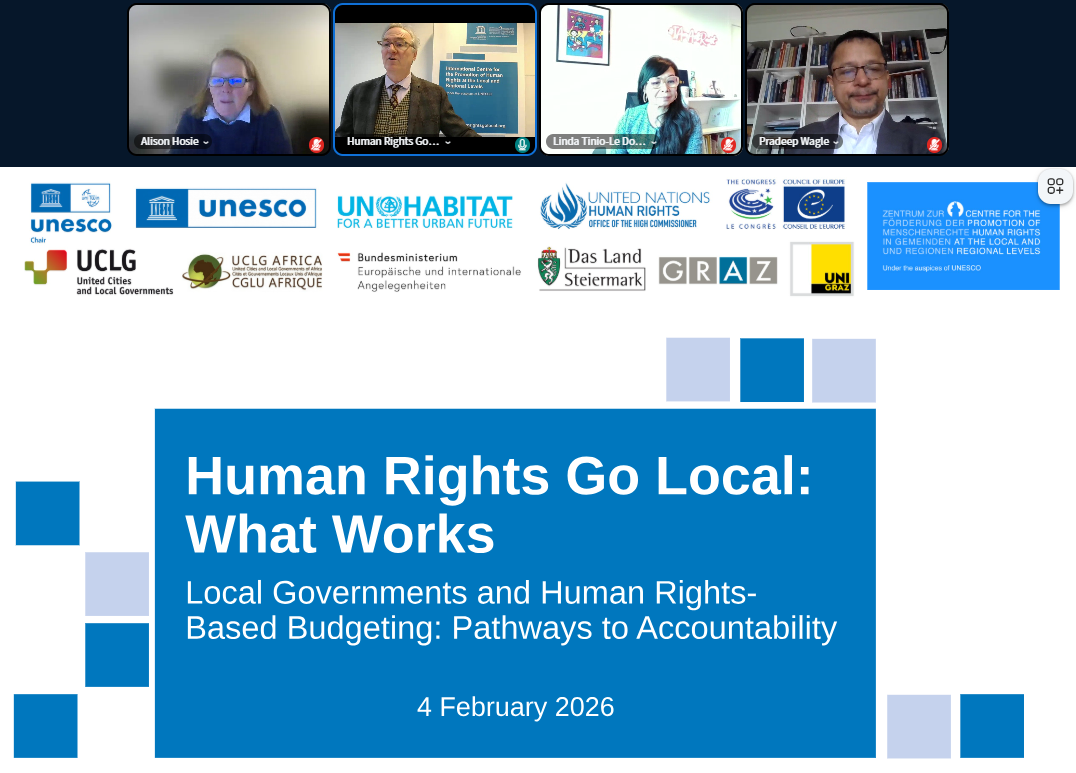
The third day of the Academy focused on how local authorities can strengthen accountability, reiterating that human rights-based budgeting are a powerful tool to move rights from commitments to practice. Pradeep Wagle, Chief of ESCR Section at the OHCHR, highlighted that while local and regional governments are increasingly responsible for delivering essential services such as health and education, their mandates are often unclear or insufficiently recognised, leading to gaps in compliance and risks of human rights violations. A key message was the need to treat rights-holders as active actors, and use practical tools such as public expenditure tracking systems and social audits. From an anti-racism perspective, Linda Tinio-Le Dourain - Deputy Chief of the Inclusion, Rights and Intercultural Dialogue Section at UNESCO - underlined that local action drives global change and that local and regional governments are key actors in eradicating racism, notably through human rights education, participatory budgeting, and inclusive governance. Representing OIDP Africa, Khadim Gueye highlighted gender-responsive participatory budgeting as a powerful lever to improve governance and respond to the concrete needs of women and girls.
Closing Conference: from outcomes to action
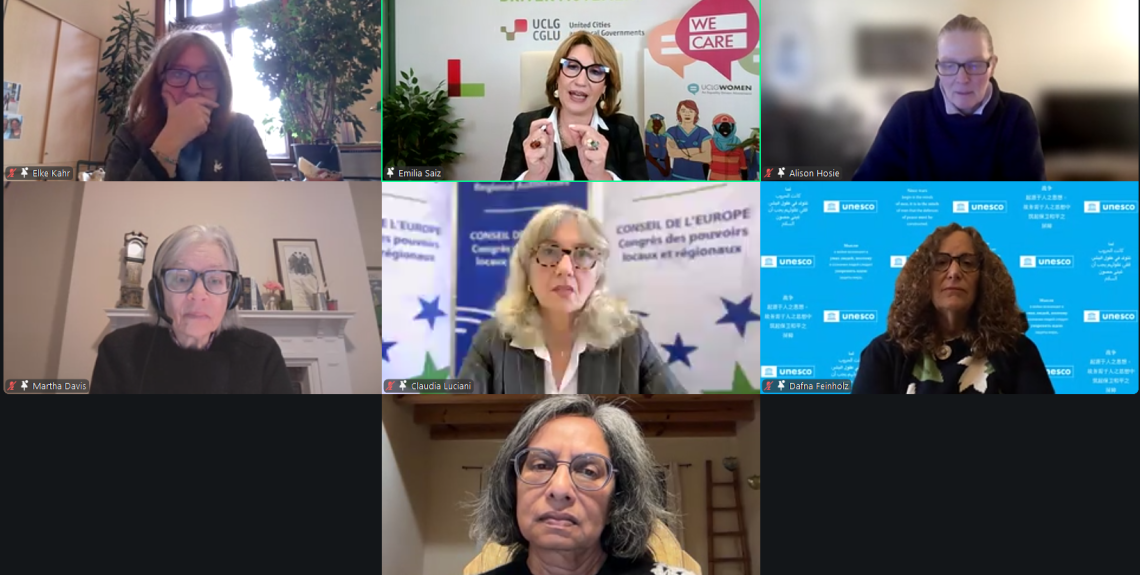
The closing conference on 5 February brought together the Mayor of Graz, Elke Kahr, and high-level representatives from academia and international organisations to discuss the outcome document of the Academy.
Anacláudia Rossbach, UN-Habitat Executive Director, highlighted that human rights start at the local level: “The local and the global are intrinsically connected: by localizing human rights, we localize our global commitments”. The UN Deputy High Commissioner for Human Rights, Nada Al-Nashif, underlined that cities face acute challenges such as informal settlements and housing shortages, and that budgets must align with human rights: “The outcome document of this academy gives us concrete points to embed human rights into budgets, and most of all, make them the norm and not the exception.”
The panel discussion underscored the central role of local leadership in translating commitments into concrete action. UCLG Secretary General, Emilia Saiz, emphasised that local governments are not merely implementers, but active political actors shaping global agendas, and called for greater recognition of their role as duty bearers of human rights. She highlighted the urgent need to address the local government finance gap and to advance a strong municipalist push to embed human rights across public service delivery and budgeting processes. As she noted, “we are not only asking for an increase in local finance, but also for a different lens through which resources are allocated.” Looking ahead to the upcoming UCLG Congress, she stressed the importance of a renewed collective strategy to place human rights at the core of the municipal agenda and guide a new generation of rights-based public services.
The Academy concluded with a clear message: Budgets reflect what — and who — we value. By embedding human rights into budgeting processes, local governments can move from commitments to action, reinforcing transparency, accountability, and trust.
UCLG reaffirmed its commitment to human rights in our collaboration with the OHCHR and deployment of the Guidance Framework for creating a Human Rights City, and the renewal of the New Global Charter-Agenda for Human Rights in the City. UCLG stands with cities and territories in the implementation of Human Rights-Based Budgeting as part of a broader municipalist movement for human rights, renewed trust and inclusive governance.