

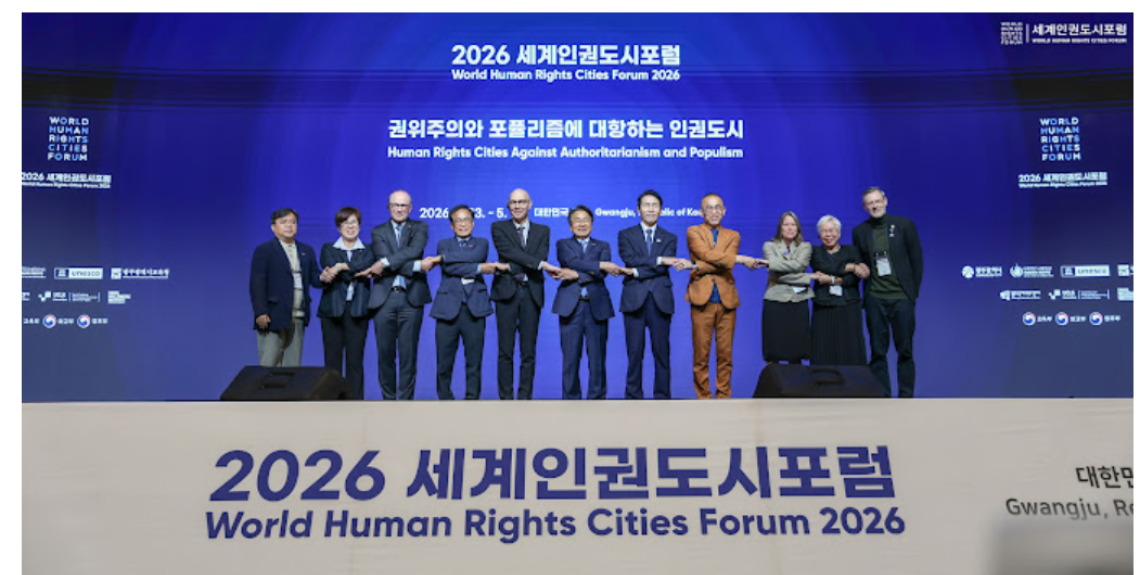
United Cities and Local Governments (UCLG), through its Committee on Social Inclusion, Participatory Democracy and Human Rights, participated as co-organizer of the World Human Rights Cities Forum 2026, held in Gwangju, Republic of Korea, from 13 to 15 May 2026. Convened under the theme “Human Rights Cities Against Authoritarianism and Populism,” the Forum brought together local and regional governments, international organizations, civil society, academia, and human rights defenders and practitioners to discuss how cities are defending democracy and human rights from the local level.
Held annually in Gwangju since 2011, the Forum has become a leading global space for the Human Rights Cities movement. Rooted in the democratic legacy of Gwangju and the May 1980 uprising, it continues to foster international cooperation, peer learning, and exchange among cities and partners committed to embedding human rights in everyday local governance.
This year’s edition focused on the growing impact of authoritarian governance and populist politics on democratic institutions, civic participation, social trust, and the rights of vulnerable groups. Discussions highlighted the responsibility of human rights cities to counter exclusion, polarization, shrinking civic space, discrimination, and attacks on pluralism, while strengthening democratic resilience, solidarity, and local multilateralism.
Cities as front lines for democracy and human rights
Throughout the Forum, participants emphasized that cities are not only where global crises are felt most directly, but also where practical democratic responses can be built. Local and regional governments were recognized as essential actors in protecting participation, ensuring access to services, promoting equality, and making human rights visible in people’s daily lives.
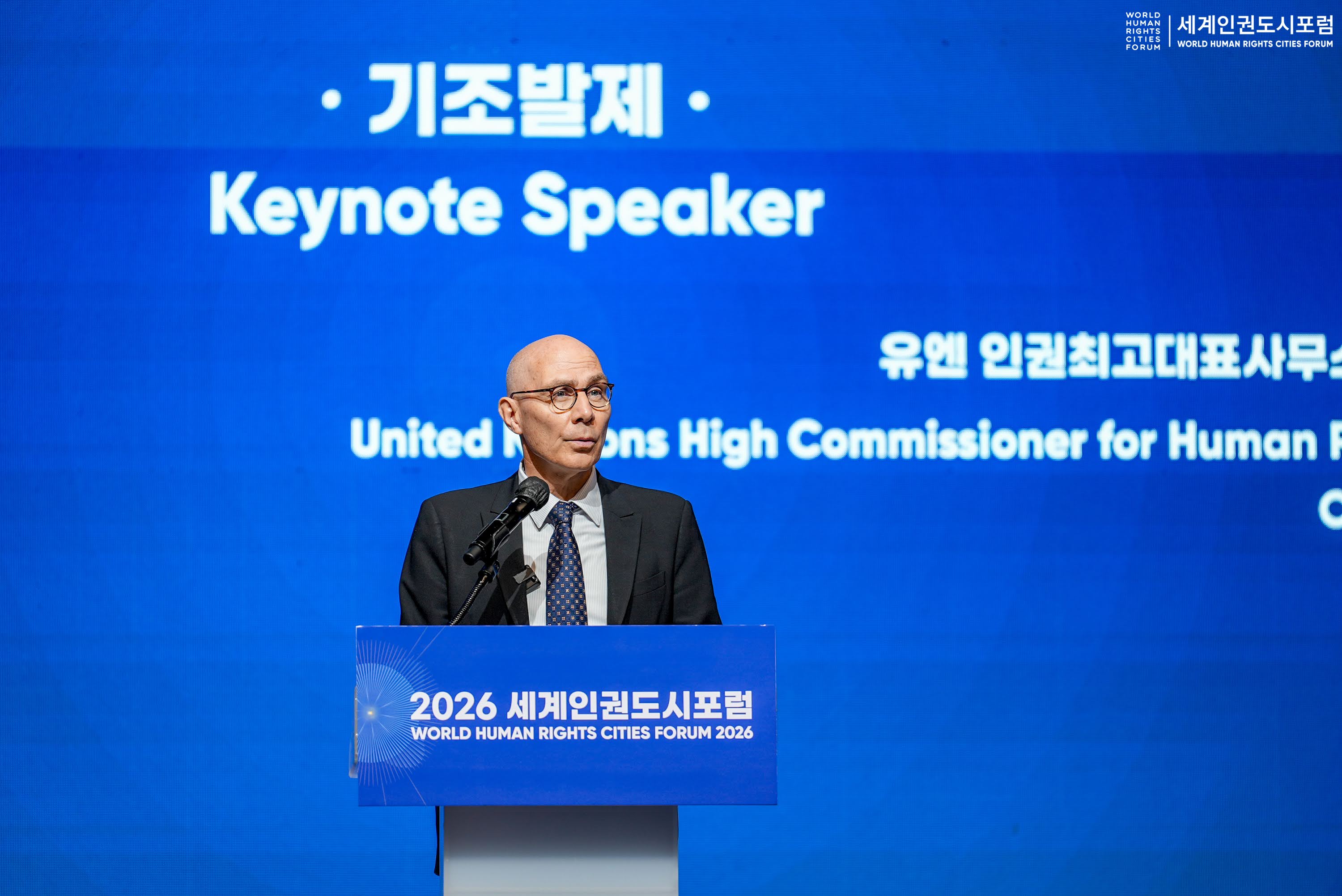
In his keynote address, Volker Türk, United Nations High Commissioner for Human Rights, underlined the importance of human rights cities in times of uncertainty:
“At times like ours, of turbulence, of uncertainty, of anxiety and confusion, human rights can be that foundation. Human rights cities are a global network of solidarity and freedom. They are harbors of certainty where the organizing principles of kindness, care, and fairness still hold.”
He also recalled that cities are on the front lines of many of today’s most pressing challenges, including poverty, inequality, inadequate healthcare and education, energy pressures, water shortages, air pollution, and other urban crises. In this context, he stressed that human rights, equality, and inclusion provide cities with a coherent governance model capable of fostering resilience, stability, and trust.
UCLG’s contribution to the Forum
As co-organizer, UCLG contributed to shaping the programme and political narrative of the Forum, ensuring that the role of local and regional governments remained central to global human rights discussions. UCLG was represented by Adrià Duarte, Head of the Committee on Social Inclusion and Human Rights, who moderated, together with Morten Kjærum, the Chonnam National University Special Session “AI, Authoritarianism, and Democratic Resilience in Cities.”
UCLG Secretary General Emilia Saiz also contributed to the Opening Ceremony through congratulatory remarks, reaffirming the importance of local action in a changing global order:
“At a moment in time where rules do not seem to apply for some, where we see our global order changing, it is critical to understand that local action can really make a difference and change the lives of more, everywhere and for everyone.”
Her remarks connected the Forum’s discussions to UCLG’s broader agenda on local multilateralism, the renewal of the social contract, and the upcoming UCLG Congress in Tangier, Morocco. She also reaffirmed UCLG’s support for the Global Campaign “10, 100, 1,000 Human Rights Cities and Territories by 2030” and highlighted the Global Charter-Agenda for Human Rights in the City as a practical framework to guide local action.
Strengthening the Human Rights Cities movement
The Forum confirmed the growing momentum of the Human Rights Cities movement and the need to scale up commitments in the coming years. Volker Türk recalled that the OHCHR Human Rights Cities Initiative has reached 104 members and highlighted the development of the Guidance Framework for creating a human rights city, prepared together with UCLG.
He also announced the upcoming launch of a new Global Alliance for Human Rights, including an initiative to strengthen the Human Rights Cities movement through new spaces for connection, exchange, and shared learning. This momentum is closely linked to UCLG’s Global Campaign, which aims to expand the number of cities and territories placing human rights at the centre of local public policies.
Peer learning was central throughout the three days, with experiences from cities, human rights institutions, civil society organizations, and international partners showing how human rights can be translated into concrete local policies, accountability mechanisms, and participatory practices.
Key discussions and programme highlights
The Forum opened on 13 May with university-led sessions on artificial intelligence, aging, human rights, and democratic resilience. The Chonnam National University Special Session, moderated by Adrià Duarte together with Morten Kjærum, examined how AI and digital transformation are reshaping urban governance, public services, housing, territorial planning, urban security, and access to resources.
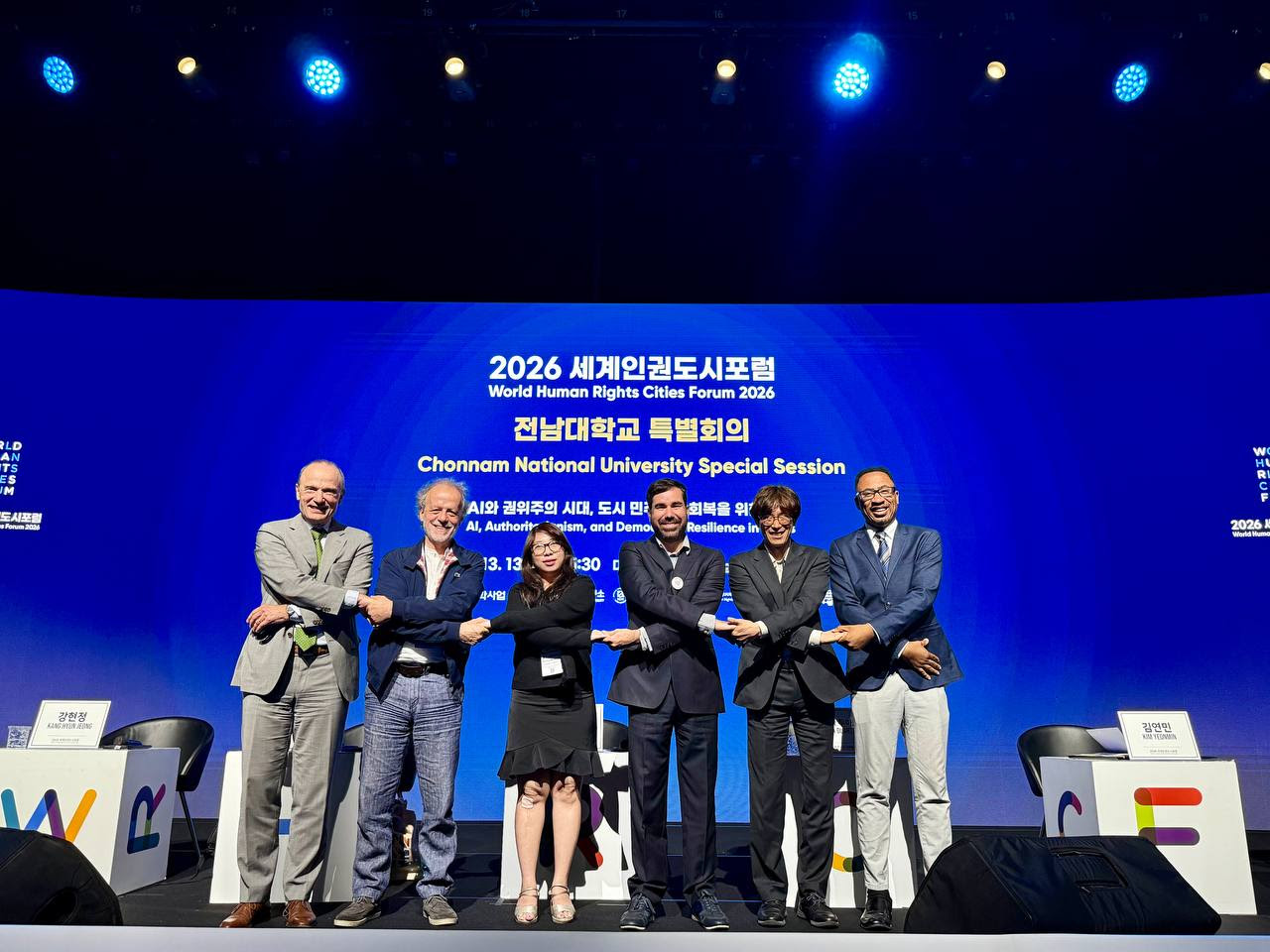
Speakers reflected on the opportunities and risks of AI-driven systems, particularly in relation to transparency, participation, privacy, non-discrimination, equity, and the right to the city. The session called for human rights-based AI governance, stronger regulatory frameworks, civic oversight, and democratic control over digital infrastructures, emphasizing that AI must be understood as a political and governance issue with direct consequences for rights, equality, participation, and democracy.
On 14 May, the Opening Ceremony and main Plenary Session placed the Forum’s central theme, “Human Rights Cities Against Authoritarianism and Populism,” at the heart of the debate. Speakers shared experiences from Korea, the United States, Thailand, and other contexts, showing how local institutions, public policies, accountability mechanisms, and civic engagement can respond to democratic erosion.
On 15 May, discussions broadened to civil society advocacy, disability rights, gender equality, human rights villages, and inclusive cities in the Asia-Pacific region. Sessions explored the impact of authoritarianism and populism on vulnerable groups, digital authoritarianism and gender gaps, and the role of inclusive and sustainable cities in advancing rights.
Partnerships and next steps
The Forum reaffirmed the importance of strong partnerships between local and regional governments, the United Nations system, UNESCO, civil society, academia, and human rights institutions. The collaboration between UCLG and OHCHR was particularly visible through their shared commitment to strengthening the Human Rights Cities movement, expanding the number of committed cities and territories, and developing tools that support local governments in applying human rights frameworks.
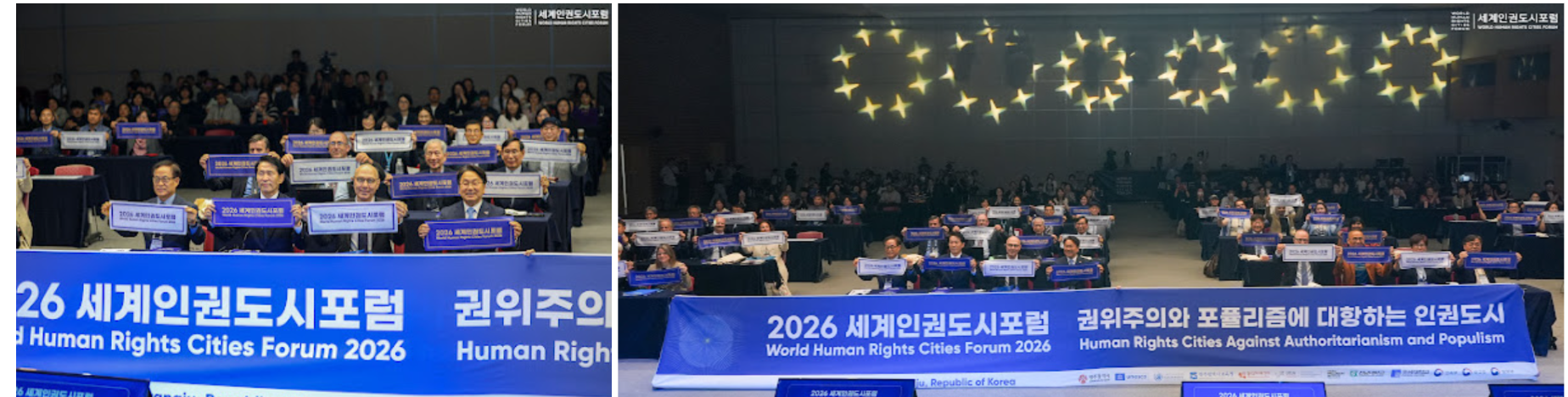
For UCLG, the outcomes of the Forum will feed into ongoing work to support cities and territories in adopting human rights-based approaches, advancing the Global Charter-Agenda for Human Rights in the City, and strengthening peer learning. They will also contribute to the road toward the UCLG World Congress in Tangier in June 2026, where human rights, local democracy, social inclusion, and local multilateralism will remain central to UCLG’s political strategy.
By bringing together political leaders, practitioners, international organizations, academics, civil society, and communities, the World Human Rights Cities Forum 2026 showed that human rights cities are not only resisting democratic backsliding. They are also building concrete alternatives based on care, equality, participation, solidarity, and democratic resilience.
More information about the World Human Rights Cities Forum is available here: https://en.whrcf.org/
Read the report from the special session “AI, Authoritarianism, and Democratic Resilience in Cities” at the World Human Rights Cities Forum 2026 (Gwangju, Republic of Korea), presented by Cesare Ottolini, Global Coordinator of the International Alliance of Inhabitants here
Read the final report of WHRCH 2026 here