

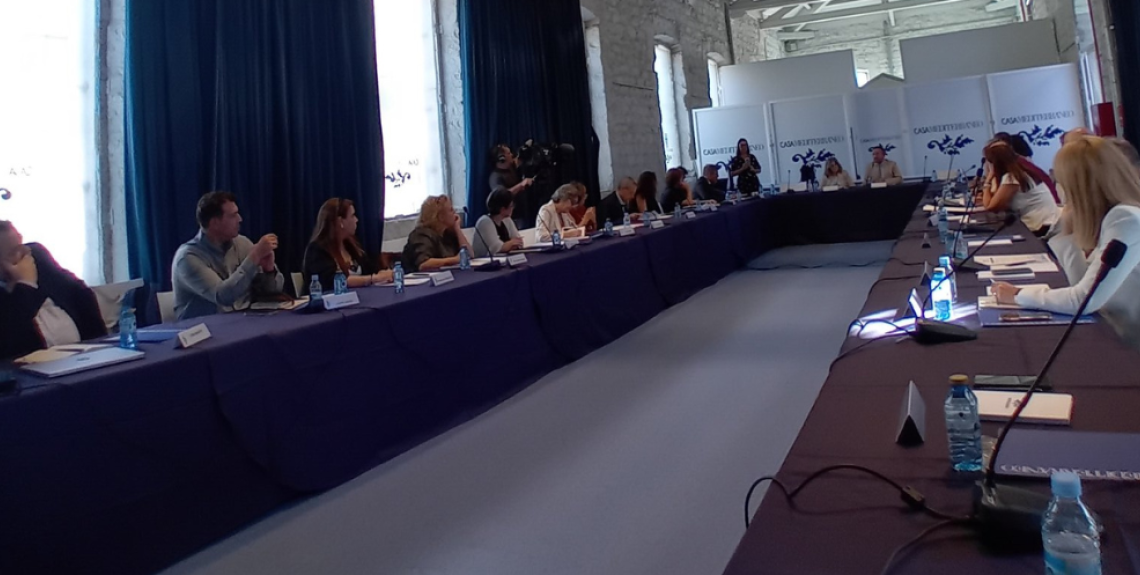
On 17 and 18 September, the Committee on Social Inclusion, Participatory Democracy and Human Rights of UCLG (CSIPDHR) participated in the International Seminar on Migration in the Mediterranean, organized by Casa Mediterráneo in Alicante. The meeting brought together policy makers, representatives of international organizations, academia, and civil society to reflect on the shared management of migration in the Mediterranean region.
In his speech, our coordinator, Adrià Duarte, emphasized the importance of this dialogue in a context marked by the rise of negative narratives on migration, the growing hyper-politicization of the issue, and the rollback of rights. “We cannot limit ourselves to reactive responses,” he said, “but must move forward with new narratives and the construction of public policies that put human rights and care at the center.”
The role of cities in reception and inclusion
Our Coordinator highlighted that Mediterranean cities are at the forefront of reception and inclusion of migrants, guaranteeing access to basic services such as housing, education, employment, health, and culture, as well as promoting participatory initiatives in partnership with civil society.
Although limited by national competences and insufficient resources, local authorities have demonstrated their capacity for innovation: from experiences of sanctuary cities in the US to municipal policies on registration and access to services in Spain or practices of inclusive participatory budgeting as in Grenoble.
Key initiatives in the Mediterranean region
Our coordinator recalled recent experiences of great relevance:
-
The Mediterranean City-to-City Migration (MC2CM) project, which strengthened local capacities and generated urban migration profiles.
-
The Lampedusa Charter (2022), adopted within the framework of the Solidarity Cities network, in which Mediterranean cities reaffirmed their commitment to the rights of migrants and refugees, defending a vision of the Mediterranean as a place of welcome and not of death.
-
The role of the Global Forum on Migration and Development (GFMD) Mayors' Mechanism, which allows local governments to bring their voice to the international debate and engage in direct dialogue with states and UN agencies.
Challenges and opportunities
Among the most urgent challenges, our Coordinator pointed to humanitarian management in coastal and transit cities, the fight against discrimination and racism, and the need to strengthen Mediterranean cooperation in order to learn from local experiences and move towards more balanced relations between the north and south.
A human rights perspective
In his conclusions, our Coordinator insisted that cities cannot be mere executors of state or European policies, but must be jointly responsible for their design. He called for the consolidation of solid multilevel governance on migration issues and recalled that migration is a structural reality that should be understood as an opportunity to strengthen social cohesion and local democracy.
“In the Mediterranean, we need to build a common horizon based on welcoming, caring for, and defending the human rights of all migrants,” Adrià Duarte.