

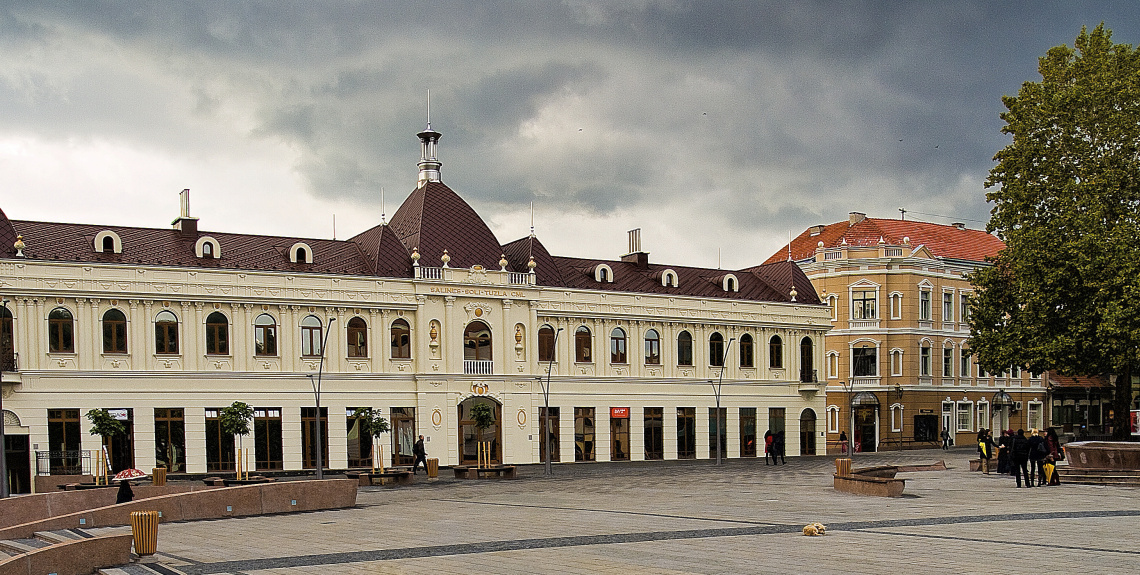
Tuzla is one of the oldest settlements in Europe with continuity of life. During World War II, on October 2, 1943, Tuzla was the largest liberated city in Europe. In the last war, from 1991 to 1995, which took place on the territory of the former Yugoslavia, the citizens of Tuzla did not divide themselves by their nationality. Their mission was to fight against the violation of human rights by protecting those rights. Instead of hatred they offered love. They fought against division by staying and fighting for liberty together. That is how Tuzla, in the middle of mass violations of human rights, caused by the war, became a symbol of human rights protection and freedoms. In such an atmosphere of harmony among differences, Tuzla has become a city in which the diversity of nations, cultures, customs, religions and languages is widely recognized and respected. In Tuzla, there is a highly developed solidarity towards all socially vulnerable population groups, which is shown in efforts to protect the weakest and to promote social cohesion. It is the responsibility of our local government to guarantee basic human rights, by all legitimate means, to all citizens, without exception: the right to quality public services, health care, social protection, a sustainable and harmonious development, the right to live in a healthy and humane environment, where equal opportunities for participation in social processes are given to everyone.
The basic human rights are universal, interdependent, and inherent to all human beings, regardless of race, sex, nationality, ethnicity, place of residence, language, religion, or any other status, and they also require the participation primarily of those to whom they directly apply – the people.
The City of Tuzla signed the European Charter on the Safeguarding of Human Rights in the City and has participated in conferences in the cities of Saint-Denis and Venice. It was Tuzla that had the honour of being the first city from Eastern Europe to host the Conference on the European Charter for the Safeguarding of Human Rights in the City, which took place in 2010. The principles contained in the Charter on the Safeguarding of Human Rights in the City fully correspond to the principles and objectives of our local government, such as principles of equal rights, solidarity and social justice, non-discrimination, tolerance and harmonious coexistence. The City of Tuzla has accepted the aforementioned responsibility with gratitude and with a strong sense of duty and obligation to create a better future for its citizens. In that respect, we understand that we need to work together with other democratic cities to diligently meet the requirements agreed upon in the face of current global challenges in human rights protection, and to ensure that the right to remain free from discrimination on any grounds, or any other violation of human rights, is ensured to everyone by higher levels of government. In this regard, cities play a very important role in the safeguarding of human rights in the context of global interests.
The City of Tuzla occupies a leading position among units of local government in B&H, in almost all areas, and it is especially well known for its openness and multiculturalism. Through many local and international projects and its departments, the City of Tuzla offers its expertise and financial support to education, culture, sports, employment, civil society initiatives, human rights implementation initiatives etc. The City of Tuzla has received several domestic and international rewards for tolerance and openness, as well as for its accomplishments in the sector of local economic development and tourism. In addition, the City of Tuzla was one of the initiators behind the network of cities signatories of the European Charter for the Safeguarding of Human Rights in the City, and the host of the Seventh Conference on the European Charter for the Safeguarding of Human Rights in the City in 2010. Therefore, the City of Tuzla is honoured to accept the invitation to join forces with other democratic cities in facing global challenges in the promotion and protection of human rights, and to ensure that the basic human rights are guaranteed to everyone.
The CPI Foundation from Sarajevo awarded the City of Tuzla the award for openness and transparency of the budget cycle. The research was conducted within the framework of the BIH Civil Society Sustainability Program, funded by the United State Agency for International Development, USAID.
The city of Tuzla invests in the expansion and reconstruction of the water supply and sewerage network in local communities where there is a need for it. Priority has been given to the capital project of long-term drinking water supply, without reductions, until 2036.
Cultural and historical heritage is an important factor of Tuzla’s growth. Therefore, the city of Tuzla, more than any other city, has invested considerable amount of budget funds and effort in the restoration of cultural and historical heritage of Bosnia and Herzegovina and Tuzla, including the reconstruction of religious monuments representing all three dominant religions in Tuzla.
The City of Tuzla participates in the implementation of the "Social Housing System" - Hilfswerk Austria (HWA) Project, aimed at socially vulnerable families or individuals who live in inadequate housing conditions and who need an appropriate form of social protection.
The City of Tuzla has become a regional leader for results achieved in the field of energy efficiency. Back in 2003, the Municipal Council adopted the Local Environmental Action Plan (LEAP), and in February 2010 the Mayor, Jasmin Imamović, signed the Covenant of Mayors - Committed to Local Sustainable Energy. The signing of the Covenant of Mayors was the foundation for the continuation of activities leading to the finalization of the Sustainable Energy Action Plan (SEAP), which was presented in Brussels in August 2011. The City of Tuzla has continued to this day to implement projects in the field of energy efficiency, in partnership with USAID, UNDP and other local and international subjects.
The City of Tuzla allocates sufficient funding from the Budget of the City of Tuzla towards the fight against poverty through provision of financial aid on a one -time basis to socially vulnerable population and beneficiaries of veterans - disability protection programme, and also to displaced persons through social housing projects. Significant help to these people is also provided indirectly through financing of the activities of the National Kitchen "Imaret", Home Care Services provided by Red Cross of the City of Tuzla, the Association of Pensioners of the City of Tuzla, and other forms of assistance to the citizens in need.
Through "Grants to non-profit organizations-associations, organizations and foundations" the City of Tuzla financially supports the following project activities: social inclusion of children and persons with developmental difficulties and disabilities and all marginalized groups, economic empowerment of persons with disabilities and marginalized groups, prevention of violence against marginalized groups, protection and promotion of child rights and human rights. The City of Tuzla continuously provides financial support from the Budget of the City of Tuzla for youth projects. Funds are allocated through a public call to youth associations from the area of the city of Tuzla mainly for projects related to youth education, human rights, democracy and gender equality, civic activism and active engagement of groups or individuals in activities and projects aimed at combating xenophobia and protecting the rights of the LGBT population. The city of Tuzla is the founder of the Public Health Institution “Dom Zdravlja” and has, over many years, made significant investments in the institution's infrastructure, for the purpose of improving the provision of health services to the citizens of Tuzla.
Through participation in the “EU Support to Local Employment Partnerships – Phase II” (LEP II) project, the City of Tuzla aims to contribute to the improvement of employment opportunities in the area of the city of Tuzla, by supporting the development of local partnerships, which are made up of educational institutions, business entities, and representatives of the governmental and non-governmental sector. The goal is to strengthen the capacity of unemployed persons to start their own businesses, and to enhance the transformation of labour supply and demand by conducting professional training and retraining of unemployed persons for deficit occupations. The City of Tuzla addresses the issues of national minorities through cooperation with national minorities and their associations. In this regard, strategic goals of Local Action Plan for the Roma Population of the City of Tuzla are aimed at improving the existing capacities of institutions and Roma organizations, and to supporting the employment and self-employment of Roma population, housing opportunities, health care, social care and education.
The City of Tuzla is a partner in the following projects: Regional Programme on Local Democracy in the Western Balkans (ReLOaD), ROMACTED "Promoting good governance and empowerment of the Roma community at the local level", Dialogue for the Future - a joint project of the United Nations implemented by UNDP, UNICEF and UNESCO under the high patronage of the members of the Presidency of Bosnia and Herzegovina (BiH), "Safe House", which is managed by the Association "Vive žene" from Tuzla, as a support for women and children victims of violence, Home Care Services for the Sick and Elderly, in cooperation with the Red Cross Tuzla, and many others.