

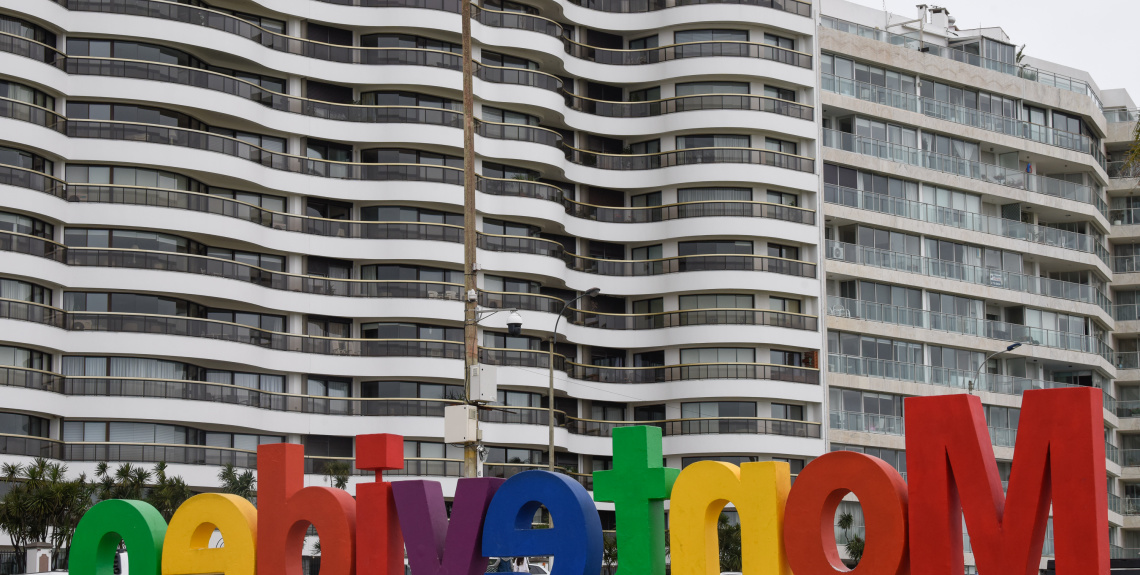
The work around human rights, as a guiding policy of our municipal government, is established in our Municipal Development Plan (MDP) 2020–2025. This government plan and commitment for the period was collectively built together with neighbors, social and cultural organizations, unions, and academia. We start from the conviction that only by expanding democracy and strengthening the existing networks in our neighborhoods, can we build what we call “The right to the city.”
This Plan, this roadmap, is also a tool for citizen oversight regarding the challenge undertaken.
This roadmap is organized into 7 components and contains in detail the 98 commitments to be developed over these 5 years. In all cases, the goal is to respond to people’s demands, needs, and desires, placing them at the center of our actions. As we mentioned, there is no possible democracy without collective construction from a human rights and right to the city perspective. The commitments undertaken involve the following components:
Component 1: Addressing social emergency: includes a series of measures that contribute to responding to the violated rights of individuals and families in our neighborhoods due to the severe economic and health emergency in our country.
Component 2: Right to the city: When we talk about the “right to the city,” it is an invitation to ask ourselves what kind of city we want, what kind of social relationships we build, what relationship with nature we value, how we care and are cared for, and what lifestyle we desire and promote. From an ecofeminist approach that questions the foundations that sustain life, the aim is to advance in the co-responsibility of care and contribute to building more accessible and inclusive neighborhoods for people of all generations.
Component 3: Living heritage: Aims to generate and disseminate projects and initiatives that promote the democratization and exercise of cultural rights. Closely linked to the urban landscape and collective memory, it fosters belonging and care for the tangible and intangible heritage in the neighborhoods. A culture free of racism, xenophobia, and all forms of discrimination is promoted, celebrating cultural diversity and valuing the different cultures and identities that coexist in the territory.
Component 4: Green neighborhoods: From an urban planning perspective, the goal is to bring rurality closer to the consolidated city, to green our neighborhoods. Our commitment is to sustainable development and food sovereignty for residents. A sustainable agenda focused on caring for people and their habitat, and for the plant heritage of our Municipality.
Component 5: Building neighborhood life: In Municipio B, different identities and ways of living in the city converge. This coexistence among neighbors is not always free of conflict. The city, the neighborhoods, are alive and constantly changing. The complex urban dynamics demand approaches that integrate both space and time. It is from this approach that we believe responses can be given to the different demands that arise for coexistence among the different ways of inhabiting the city.
Component 6: Reclaiming the streets: Emphasizes the most emblematic part of our proposal, as the street is the essence of the city. The more uses we give and the more appropriation we make of our streets, the safer, more inclusive, and more enjoyable our city and its neighborhoods will be. Our proposal aims to inhabit the streets and public spaces from a place of desire.
Component 7: Proximity municipality: A proximity municipality is transparent in its management. It helps strengthen spaces and organizational networks, social and local participation. For this municipal government, citizen oversight is essential to strengthening democracy. It is also fundamental to tag actions in its budget and accounting reports with regard to gender, anti-racist, ecological, and human rights agendas. All this constitutes, in our view, a policy of transparency.
We are motivated by the possibility of re-signifying human rights through a daily, neighborhood-level lens and having them understood from an egalitarian and inclusive perspective as the foundation of human rights. The Municipal Council unanimously voted in its ordinary session on August 17 to join this campaign of the first 100 human rights cities and territories.
1) Municipal Care Plan
This Plan is the result of a series of actions stemming from a collective and transformative process that seeks to fulfill the commitment established in the Municipal Development Plan 2020–2025 to “Build a municipal care plan together with feminist collectives, care networks, older adults, children and adolescent networks, revaluing the reproduction of life, eco-dependence, and co-responsibility as central elements of the right to the city.”
The mentioned actions involve:
-
Care polygon: improvement works – sidewalks, ramps, trees, pruning, planting – and incorporation of urban equipment in a pilot area to move toward a more inclusive and friendly city for all people and nature.
-
Visualization tool that brings information on available care services in the territory closer to the public. [Technological innovation]
-
Training, workshops, and identification of care referents at the institutional level and within community and governance networks. [Transversality and intersectionality].
-
Summer care slots: recreational and care services provided (outside school hours and during vacations). [Co-responsibility policy focused on women with children].
-
Awareness campaigns to promote co-responsibility in care between men and women. [Cultural change – Feminism]
-
Neighborhood assemblies, meetings, workshops, and participatory surveys to highlight the role of care in life. [Citizen diagnosis, opinion poll and demographic profiling, work with local businesses].
The plan adopts a specific methodology and ethical-political positioning consistent with its objectives, namely:
-
From a feminist urban planning perspective, guided by the principles of eco-dependence, interdependence, and co-responsibility.
-
Participatorily, based on existing neighborhood networks, sharing knowledge with neighbors, in neighborhoods, with the community, academia, and organized civil society.
-
Innovating: aiming to generate and bring concrete and meaningful care experiences to neighbors. With active participation in national and global forums to help place care on the public agenda.
-
Recognizing and respecting anti-racist, feminist, ecological, and commons-enhancing agendas.
2) People in street situations and the right to the city
The commitments made in the MDP 2020–2025 regarding this topic are as follows:
-
Development of a participatory mapping together with the collective Ni Todo Está Perdido (NITEP), the University of the Republic (UdelaR), the Friedrich-Ebert-Stiftung Uruguay Foundation (Fesur) to identify needs (services, infrastructure) associated with the life paths of people in street situations. This mapping was carried out based on an agreement signed between Fesur, UdelaR, and NITEP on August 19, 2021. The mapping enabled a participatory action-research project conducted by UdelaR faculty and NITEP members in agreement with Fesur and Municipio B. The work allowed a reading of the city through the lens of people in street situations and serves as a valuable input for public policy design.
-
Construction of a daytime cultural center – construction works to begin in 2023.
-
Strengthening the public restroom network, ensuring their maintenance and care. A network of 5 accessible public restrooms has been established in the territory of Municipio B. This responds to a public demand to claim their right to inhabit the city with the necessary care for that purpose.
-
Development of a communication campaign to foster empathy and awareness toward homeless individuals and help destigmatize this population. – This campaign will be carried out in 2023. A documentary reflecting the mapping process with NITEP is available as a preliminary resource.
-
Participation in coordination spaces with the university community, organized civil society, and unions to build training and job opportunities aimed at the most vulnerable people. – Continuous collaboration with these stakeholders is maintained to promote job inclusion for the most vulnerable sectors.
-
Integration and active participation in the coordination space “Street Advisory Council.” – Municipio B participates actively in this Council.
-
Generation of educational-labor agreements aimed at responding to income generation needs of highly vulnerable people – Employment has been provided to 16 homeless individuals under such agreements.
3) Anti-racist Municipality
Within the Living Heritage component established in the MDP, recognition of intangible heritage and the need to safeguard and promote local identities and the cultural heritage of communities and neighborhoods are emphasized.
In this context, each July, the Month of Afro-Descendance, Municipio B carries out a series of actions to promote and recognize the full exercise of the rights of Afro-descendant people and contribute to the fight against racism and xenophobia in the neighborhoods. Additionally, it supports and accompanies activities carried out by organizations and collectives present in the territory of the Municipality.
In this framework, the campaign “Proudly Afro” was carried out in 2021 – aimed at contributing to the recognition of the Afro-descendant community and their rights – along with “My neighborhood is anti-racist,” to promote and make visible the commitment to ethnic-racial equality and anti-racist efforts present in the neighborhoods of the Municipality.
Likewise, on the occasion of the National Day of Candombe, Afro-Uruguayan Culture, and Racial Equity every December 3rd, a program of activities is promoted in the various neighborhoods of the Municipality.